

Tags
Read time
8 min read
Last updated
June 30, 2026
Ketch makes consent banner set-up a breeze with drag-and-drop tools that match your brand perfectly. Let us show you.

The term "agentic privacy" is being used across the industry to describe everything from AI chatbots to compliance dashboards. This guide is specific about what it actually requires, and what separates continuous, cross-domain gap closure from tools that are AI-adjacent at best. Agentic privacy uses AI agents to automatically, in real time, and across the full scope of an enterprise privacy program, monitor and close gaps among privacy regulations, organizational policies, and live systems. Privacy teams spend 80% of their time gathering context before they can identify a single risk. Agentic privacy eliminates that overhead.
Agentic privacy is the use of AI agents to continuously close the gaps between privacy regulations, organizational policies, and live system behavior, automatically and in real time.
That definition matters because the privacy industry is awash in tools claiming to be "AI-powered." Most of them are chatbots wearing compliance badges. A chatbot answers questions when you ask. An agent acts without waiting to be asked, and that distinction is the entire ballgame. The word "agentic" is doing a lot of heavy lifting in privacy vendor marketing right now. This guide is specific about what it means and what it requires.
Privacy teams today are more accountable than ever. Global regulations. AI governance mandates. Accelerating enforcement. A wave of demand letters that punish the unprepared. Underneath all of it, the same persistent problem: too much context to gather, too many blind spots, and too little time to act on it.
The average enterprise privacy program touches dozens of systems, hundreds of vendor contracts, and thousands of data flows. Keeping up with the gaps between what regulations require, what policies commit to, and what systems actually do has always been a manual exercise. It was exhausting before AI entered the picture. Now it's functionally impossible to do by hand.
Read more: Comparing the best data privacy software
This guide defines agentic privacy, explains why it's become essential in the AI era, and gives privacy leaders, marketing, security teams, and engineers a practical framework for implementation.
Agentic privacy is the use of AI agents to continuously identify and close the gaps between what privacy regulations require of an organization, what that organization's documented policies commit it to, and what its systems are actually doing, automatically and in real time.
The keyword here is continuously. Privacy programs that rely on periodic assessments, annual audits, and survey-based reviews are working with a snapshot of a moving target. By the time the survey responses come back, systems have changed, new vendors have been added or removed, and a new state law has gone live. The snapshot is already out of date.
Agentic privacy replaces the snapshot with a live view. AI agents monitor your regulatory environment, policy documents, and operational systems simultaneously and flag discrepancies the moment they emerge, not six months later, when the next audit cycle begins.
Not all vendors mean the same thing by agentic privacy.
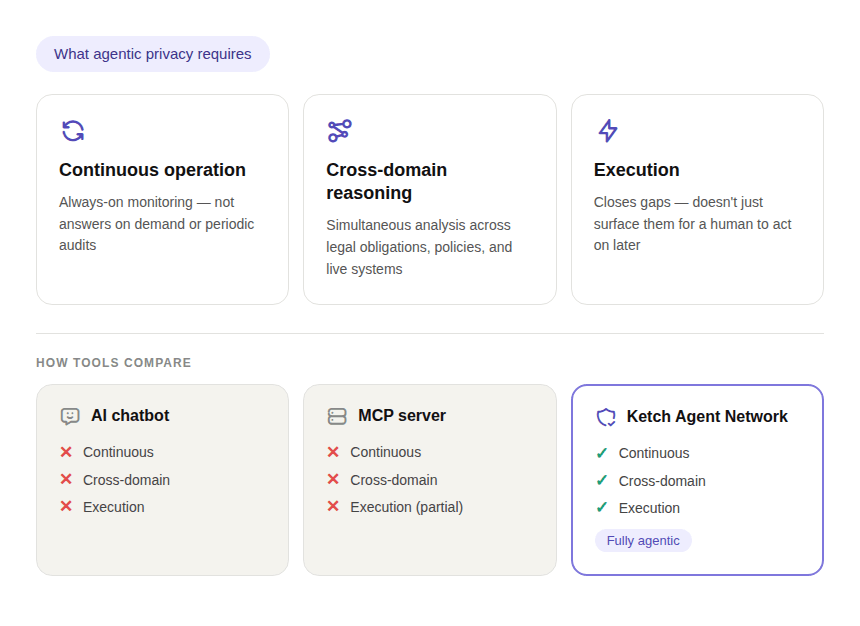
These are useful tools, especially a few years ago. But none of them is agentic privacy in the operational sense — because none of them act continuously, reason across multiple domains simultaneously, or execute remediation without waiting to be asked. A tool that surfaces a gap is monitoring. A tool that closes the gap is acting. At best, most of what the market is selling today is the former, labeled as the latter.
Agentic privacy is not a chatbot that answers privacy questions when prompted. Chatbots are useful, but they are not agents. An agent can act without waiting to be asked.
It is not an MCP server that exposes privacy tools to engineers who know how to use them. These niche solutions assume a level of technical expertise and developer background that many privacy teams don’t have.
An agentic privacy platform is a purpose-built system that uses those tools to solve end-to-end privacy problems without requiring your engineering team to build the workflows. It is not a single-domain AI that analyzes your policy documents, or your regulatory environment, or your system configurations — one at a time, in isolation. The insight that closes a privacy gap almost always requires reasoning across all three of these domains.
How Ketch defines agentic privacy: Agentic privacy is about machines helping identify the work that needs to be done in a privacy program — and providing the tools and automation to actually do that work — with as few human hours as possible. That definition requires something things most "agentic" privacy tools don't deliver: multiple agents continuously working across all three data domains critical to the privacy program: legal obligations, documented policies, and live systems. It also requires the ability to execute remediation, not simply report on it.
Read more: The Ketch Agent Network
Traditional privacy operations were designed for a world where data collection was relatively contained, regulatory obligations were relatively stable, and the number of systems processing personal data was manageable by a team of humans with spreadsheets and periodic reviews.
None of those assumptions hold anymore.
When a consumer consented to personalized product recommendations in 2022, they probably didn't consent to their behavioral data being used to fine-tune a large language model in 2026. Whether that distinction matters legally varies by jurisdiction, DPA language, and the specifics of how the model was trained — but the gap is real, and it's growing.
Every time an AI workflow calls a third-party model API, it's potentially creating a new sub-processor relationship. Most DPAs don't contemplate this. Many privacy policies don't disclose it. The gap between what organizations commit to in contracts and what their AI systems are actually doing is widening every quarter.
A human-managed privacy program can track hundreds of data flows with effort. AI agents in a modern enterprise can generate thousands of processing events per minute. The only way to govern AI at AI scale is with AI.
Honda paid $632,000 to the California Privacy Protection Agency in 2024 for misconfigured systems that created asymmetrical opt-out processes. Todd Snyder paid $345,000 for failed opt-out processing due to misconfiguration and excessive verification demands. The argument "our policy was compliant, our systems just didn't enforce it" has not been a successful defense. It won't be.
In Italy, the DPA suspended DeepSeek's operations in early 2025 over concerns about data provenance and transparency, exactly the kind of gap that emerges when AI pipelines process personal data without documented legal bases. These enforcement actions illustrate that AI governance is no longer theoretical. Regulators are acting.
This is the environment agentic privacy was built for.
The hardest part of running a privacy program isn't any single task. It's the reconciliation problem: balancing what the laws say you're supposed to do, what you personally say you're doing, and what you're actually doing, and finding the daylight between all three.
Privacy risk doesn't live in any one of these domains. It lives in the gaps between them.
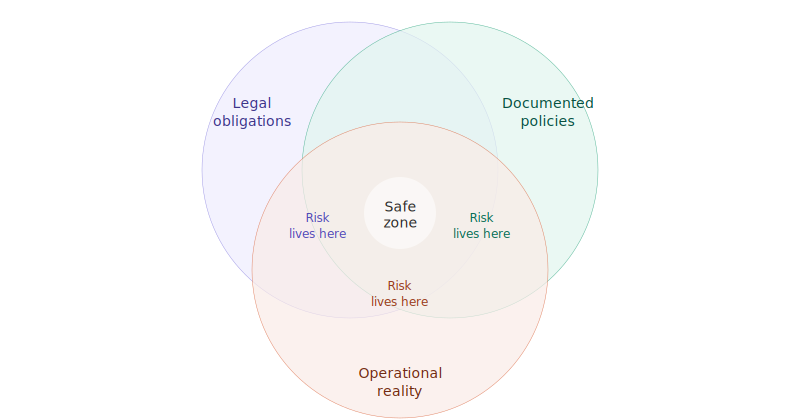
This domain includes global privacy laws, U.S. state regulations, enforcement actions, regulatory guidance, and settlements. It's the moving floor. New laws come into effect. Enforcement actions reinterpret existing requirements. Regulators publish guidance that changes what "reasonable" means. This domain never stops moving.
This domain includes privacy policies, vendor DPAs, subprocessor lists, internal data processing policies, compliance documentation, and your knowledge base. This is your commitment layer — the record of what you've told regulators, customers, website visitors, and vendors you do with their data.
This domain includes your data repositories, collection points, access controls, system configurations, consent management platform settings, DSR automation workflows, and anything else that governs how personal data is actually handled. This is the ground truth, and it's almost always different from what the policy documents say.
Less than 30% of organizations can automatically enforce data governance today (Gartner research). That statistic describes the gap between Domain 2 and Domain 3 at enterprise scale. Consider these common scenarios:
These gaps are normal. They multiply as organizations grow. And finding them manually — reading every contract, auditing every configuration, cross-referencing every enforcement action — is the work that consumes up to 80% of a privacy team's time before they can identify a single risk.
Agentic privacy surfaces these gaps continuously, prioritizes them by enforcement history and severity, and routes them to the right people to close.
An agentic privacy program has four functional layers. These map directly to what a purpose-built platform like the Ketch Agent Network provides, and they represent the architecture that separates a genuinely agentic system from tools that handle only one layer at a time.
Continuously ingest and classify data from all three domains. This means connecting to regulatory databases and enforcement feeds (Domain 1), ingesting and synthesizing policy documents, DPAs, and contracts (Domain 2), and integrating with SaaS systems, consent management configurations, and DSR workflows (Domain 3).
This is not a one-time import. It's a live feed. When a new settlement is published, the system ingests it. When a DPA is updated, the system re-synthesizes it. When a system configuration changes, the system detects it.
Apply your organization's policies, risk tolerance, and compliance commitments as the interpretive layer across captured data. This is what transforms raw data into meaningful gaps. A configuration change is just a change until the policy layer says it violates a documented commitment — then it becomes a risk.
Execute remediation. This is what separates an agentic privacy platform from a compliance dashboard. Finding a gap and displaying it is monitoring. Finding a gap and closing it — by executing a Ketch configuration change, routing a contract gap to the right team with the specific regulatory citation, or updating an assessment with contradictory data — is agentic.
Log every action, every gap surfaced, every remediation executed, and every approval given by a human reviewer. This is the compliance demonstration layer. When a regulator asks you to prove your data practices match your privacy policy, the audit log is your answer.
Your primary concern is the gap between Domain 1 (legal obligations) and Domain 2 (documented policies). New regulations, enforcement actions, and guidance introduce requirements that may not be reflected in your current DPAs, privacy policies, or compliance documentation.
What agentic privacy does for legal teams:
In 2022, Sephora was fined $1.2 million by the California AG for failing to honor consumer opt-out requests. The problem wasn't their policy, it was the gap between what the policy said and what their systems did. That's the gap agentic privacy is built to close.
Key metric to track: Time from regulatory event to verified compliance (the gap between a new requirement going live and your policies and systems reflecting it).
Read more: Ketch for legal teams
Your primary concern is the gap between Domain 2 (documented policies) and Domain 3 (operational reality). Systems get misconfigured. New vendors get added without DPA review. Trackers continue collecting data after opt-out. AI agents access data stores they shouldn't.
What agentic privacy does for security teams:
Ketch research found that 40% of all trackers ignore consumer opt-outs, generating 215 billion dirty data events per month across 134 major websites analyzed (Ketch research). That's not a policy problem, it's an operational reality problem. Agentic privacy closes it.
Your primary concern is integration depth and operational efficiency. You need a system that actually connects to your SaaS stack, accurately classifies data without manual labeling, and doesn't require your team to build custom workflows to realize value.
What agentic privacy does for engineering teams:
The goal: a data map that updates itself. Not a project that restarts every quarter.
Read more:
Your primary concern is data quality and activation. Agentic privacy affects marketing teams less through direct compliance requirements and more through the quality of the consented first-party data available for AI-powered personalization.
What agentic privacy does for marketing teams:
82% of people are concerned about how their data is being gathered and used. 81% see the value in sharing it in exchange for something meaningful (Ketch research). The difference between those two statistics is trust, and trust is a product of privacy done right.
Read more: Ketch for marketing teams
The EU AI Act came into full effect in 2025. Most of the coverage has focused on model providers and high-risk AI system operators. What's gotten less attention is the data governance obligation that applies to virtually every organization using AI to process personal data in the EU.
Article 10 of the EU AI Act requires that training, validation, and testing datasets for high-risk AI systems meet data governance and management practices — including data quality, relevance, and the removal of biases. For privacy teams, this means demonstrating not just that your AI systems comply with GDPR, but that the data used to train and operate them was governed appropriately from collection through use.
This is not an ML safety team's job. It's a data governance job. It requires consent records, processing activity documentation, and audit trails for data used in AI pipelines — exactly what an agentic privacy platform produces.
The Italian DPA's suspension of DeepSeek in early 2025 — on grounds of insufficient transparency about data flows and legal bases for processing — illustrates where Article 10 enforcement is heading. Organizations that cannot document the provenance and governance of their AI training data are exposed.
As of 2026, 20+ U.S. states have enacted comprehensive privacy laws. The operational challenge for multi-state businesses isn't understanding the laws, it's keeping configurations current as requirements change and differ across jurisdictions.
California enforcers have been most active, with the California AG and CalPrivacy enforcing actively: Honda ($632,000), Todd Snyder ($345,000), and Jam City ($1.55 million for failure to manage minors' data in mobile gaming) are all 2025 enforcement actions. Texas, Colorado, Virginia, and others are ramping up. The common thread in recent enforcement: the gap between stated policy and operational practice. Companies are being fined not for bad policies, but for systems that don't enforce the policies they've written.
Agentic privacy addresses this directly. Instead of relying on annual audits to catch drift between policy and system configuration, an agentic system detects it the moment it occurs and routes it for remediation before it becomes a liability.
Read more: Privacy Regulation Hub
Before any AI agent system goes into production touching personal data, privacy and security teams should verify these 15 controls are in place.
The work of running a privacy program doesn't fit in one context window. It never did. The regulations are too numerous, the systems too many, the vendor relationships too complex, and the enforcement environment too active for any human team to manage by hand, let alone keep current in real time.
Agentic privacy changes the equation. Not by replacing the privacy team, but by eliminating the context-gathering overhead that consumes most of their time — and replacing it with prioritized, actionable insight and the ability to execute. The market will catch up on the terminology eventually. In the meantime, the gap between what vendors call agentic and what agentic actually requires is where the risk lies.
The Ketch Agent Network is the platform that makes agentic privacy operational for enterprise teams. It reasons across legal obligations, documented policies, and operational reality simultaneously. It surfaces gaps with the regulatory citations to understand them and the remediation steps to close them. And it executes — inside Ketch, on approval — so the gap doesn't sit in a report waiting for someone to act.


